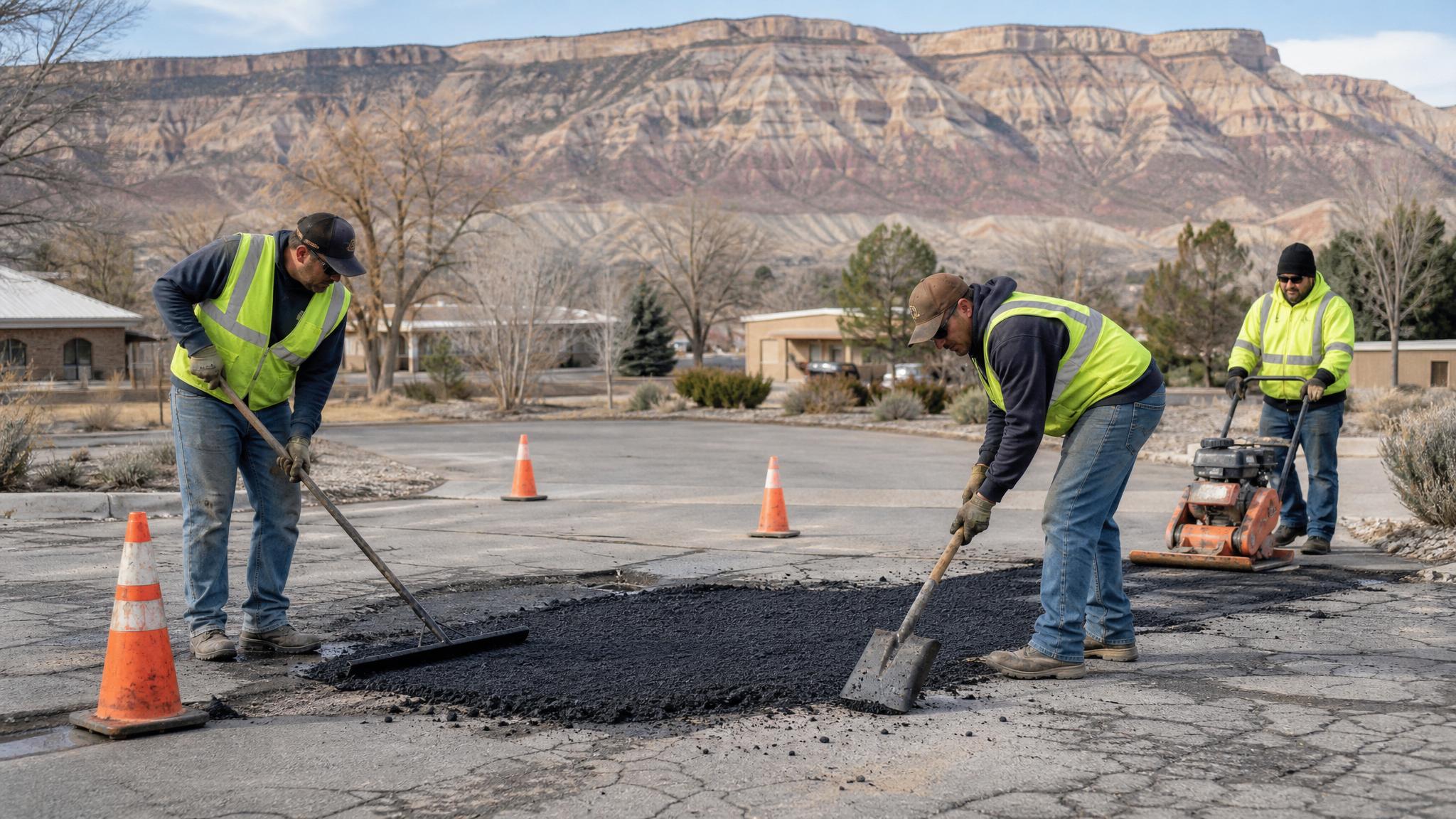
Pothole repair in Grand Junction
Potholes can create trip hazards, vehicle damage, drainage problems, and a rough first impression for customers, tenants, delivery drivers, and homeowners. This page helps property owners describe pothole and pavement failure issues clearly before requesting an asphalt repair estimate, so the contractor can tell whether the problem looks like a surface patch, a full-depth repair, a drainage issue, or part of a larger pavement failure pattern.
Most pothole requests start with the same practical questions: how many failed areas are present, whether the damage is isolated or spreading, whether water is sitting in the hole, and whether the surrounding asphalt still has enough structure to hold a patch. In Grand Junction, it also helps to note whether the pothole sits in a shaded winter area, a truck turning path, a gutter line, a low spot, or the edge of older asphalt where the base may be exposed.
Common pothole repair situations
- Commercial parking lot potholes near entrances, drive lanes, loading areas, or ADA routes
- Driveway potholes caused by freeze-thaw cycles, drainage problems, heavy parking, or edge failure
- Failed patches where older repairs have broken loose or settled
- Utility-cut repair after trenching, line work, or surface disturbance
- Low spots that hold water after rain or snowmelt
- Edge failure near traffic lanes, shoulders, private roads, or unprotected pavement borders
A single clean pothole can sometimes be handled as a targeted repair. Multiple potholes in a traffic lane, repeated failures in the same area, or damage surrounded by alligator cracking usually deserves a closer look at the base, drainage, and adjacent asphalt before another patch is installed.
Details that help clarify a pothole estimate
When requesting an estimate, include the property type, approximate number of potholes, the largest damaged area, whether vehicles currently drive over it, whether the hole holds water, and whether the surrounding asphalt is cracked or crumbling. Photos from several angles can help a contractor decide whether the work looks like patching, saw-cut repair, or a broader resurfacing problem.
Useful photos include a close view of the broken edge, a wider view showing traffic flow or drainage slope, and one image with a tape measure, boot, cone, or other scale reference. For commercial properties, include the nearest entrance, loading area, tenant suite, or drive lane so repair timing and access can be discussed.
Patching, saw-cut repair, or larger asphalt repair?
- Patch repair may work for isolated holes where the nearby pavement is still stable, the failed material can be cleaned out, and the surrounding asphalt is not breaking apart.
- Saw-cut or full-depth repair may be needed for failed areas where loose material needs to be removed back to stronger edges and the repair needs a cleaner tie-in than a quick surface patch.
- Resurfacing or overlay may be worth discussing when potholes are part of broader cracking, raveling, oxidation, or surface failure across a drive lane or parking area.
- Drainage correction may be needed when the same pothole keeps returning because water sits in the repair area.
Commercial pothole repair considerations
For retail centers, offices, apartments, churches, warehouses, and small commercial lots, timing and traffic control matter. It helps to note business hours, high-traffic areas, delivery routes, tenant access needs, and whether temporary lane closures or phased repair would be preferred.
Property managers should also separate urgent hazard repairs from longer-term pavement planning. A pothole in a pedestrian route, fire-lane approach, delivery path, or main customer drive aisle may need faster attention, while scattered low-risk patches can often be grouped with crack sealing, sealcoating, striping, or a larger parking lot maintenance plan.
When patching is not enough
Repeated potholes, widespread alligator cracking, drainage trouble, rutting, base failure, or multiple failed patches can point toward full-depth repair, resurfacing, or replacement rather than another small patch. This site accepts estimate requests so project conditions can be reviewed and the right scope can be discussed.
The goal is not just to fill a hole for a few weeks. A stronger repair plan should consider why the asphalt failed, how traffic uses the area, whether water is undermining the base, and whether a patch will blend into nearby pavement without creating another weak edge.
Frequently asked questions
Why does Grand Junction asphalt get so many potholes?
High-desert UV exposure oxidizes and stiffens the asphalt binder over time, and winter freeze-thaw cycles push meltwater into small cracks, then expand it as it refreezes. That combination turns small surface cracks into potholes faster than in milder climates.
Can a pothole be patched permanently, or does it come back?
A properly cleaned and compacted patch can hold up well, but a pothole that keeps returning in the same spot usually points to a drainage or base problem underneath rather than a patching defect. Those cases often need a saw-cut repair or drainage correction instead of another surface patch.
How fast can a pothole get worse in Grand Junction?
A small crack can widen into a pothole within one freeze-thaw season if water keeps getting underneath the surface, especially in shaded areas or low spots that hold snowmelt. Traffic loading over the softened area speeds up the failure.
Is pothole repair cheaper than resurfacing?
Per square foot, patching is usually less expensive than a full resurfacing or overlay. But if potholes are widespread across a driveway or lot, repeated patching can cost more over a few years than addressing the surface once. The cost factors page covers this tradeoff in more detail.
Should I fill a pothole myself before requesting an estimate?
A temporary cold-patch fill can reduce a trip hazard, but it is not a substitute for a proper repair and can make it harder to see the true extent of the damage. Photos of the pothole before any temporary fill are more useful for an estimate.
Do commercial properties need faster pothole response than residential?
Often yes, particularly for potholes in pedestrian routes, ADA stalls, fire-lane approaches, or main drive aisles where liability and daily traffic are higher. See the parking lot maintenance page for how repairs fit into a broader maintenance schedule.
Related asphalt repair pages
- Asphalt Repair Grand Junction CO
- Asphalt Resurfacing and Overlay Grand Junction CO
- Crack Sealing Grand Junction CO
- Parking Lot Maintenance Grand Junction CO
- Commercial Parking Lot Paving Grand Junction CO
Asphalt services in Grand Junction, the Grand Valley, and nearby Western Slope communities
- Asphalt Paving Grand Junction CO
- Driveway Paving Grand Junction CO
- Parking Lot Paving Grand Junction CO
- Asphalt Repair Grand Junction CO
- Pothole Repair Grand Junction CO
- Sealcoating Grand Junction CO
- Crack Sealing Grand Junction CO
- Asphalt Resurfacing Grand Junction CO
- Parking Lot Maintenance Grand Junction CO
- Parking Lot Striping Grand Junction CO
- Private Road Paving Grand Junction CO
- Asphalt Paving Cost Grand Junction CO
- Grand Junction Service Area
- Fruita Asphalt Paving
- Clifton Asphalt Paving
- Palisade Asphalt Paving
- Western Slope Asphalt Paving
- Contact / Estimate